The data on AI usage reveals an interesting divide: while a majority of people have either tried AI tools like ChatGPT, Copilot, or similar models once and never returned, or have not tried them at all, a smaller subset of users engage daily. This gap often results from misunderstandings and subpar experiences, which usually stem from a lack of knowledge on how to effectively interact with these models. AI tools, especially large language models (LLMs), are designed to respond based on how well a prompt is structured. If users aren’t getting the results they expect, it’s often not due to the tool’s limitations but rather the prompt’s construction.
At FHU, we are leveraging AI tools to streamline internal business processes, enabling greater efficiency and improving the quality of outputs. Through presentations across the US, we share our experiences and insights with clients and partners, helping them integrate these tools into their workflows.
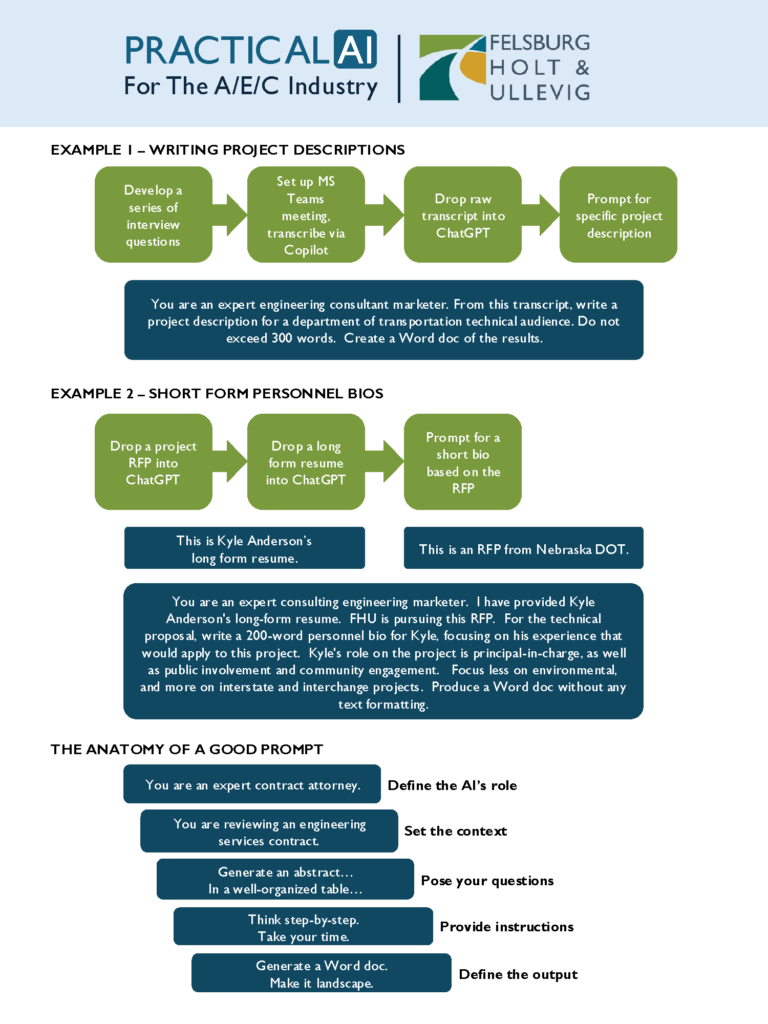
A key element of success lies in mastering the art of crafting an effective AI prompt. To achieve optimal results, prompts must be clear, concise, and directive, ensuring the AI understands the context and intent. This approach allows AI models to generate high-quality, relevant responses.
Steve Ingracia’s “Practical AI” presentation offers specific examples demonstrating how we apply this at FHU. These include writing project descriptions, generating personnel bios, and reviewing engineering services contracts. In each of these cases, effective prompt design results in outputs that are both accurate and practical. By sharing these strategies, we aim to help others unlock the full potential of AI, transforming it from a novelty into a tool that enhances everyday work processes, driving meaningful improvements in efficiency and decision-making.
Steve Ingracia, PE
National Services Director & Principal